Third Sunday of Easter, Year A

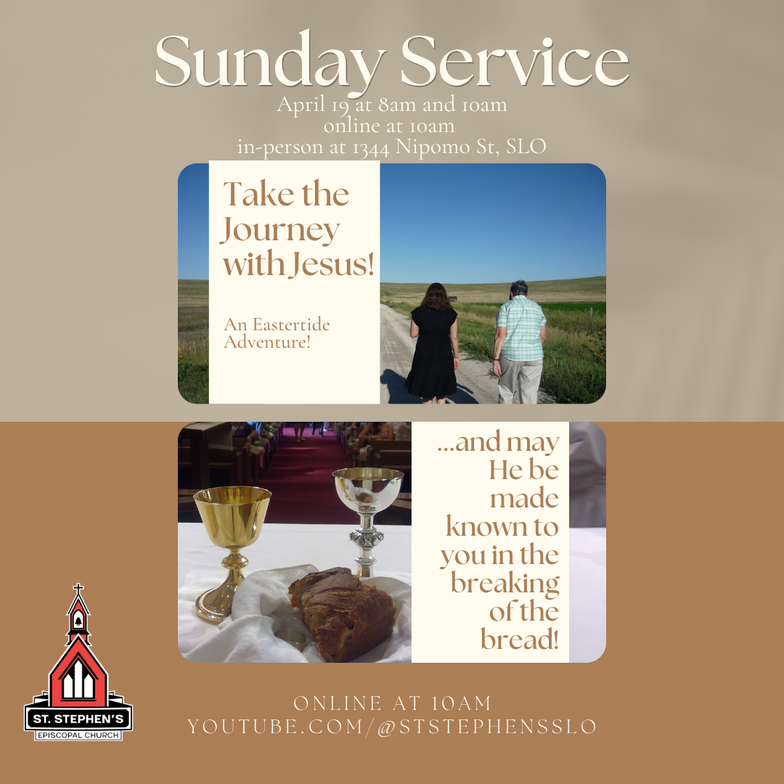
This morning, our Eucharist will be in the context of a meal. And because of that, the parts of the service are in very different places. Mashing together Jewish table traditions with Episcopalian rubrics for the Eucharist is a bit like quilt-making.
If you have not experienced this type of Eucharist before, it may seem a bit strange. In actuality, the way we celebrate the Eucharist is strange. The sharing of the Eucharist in the Early Church was always in the context of the meal of the day.
Jesus, as a Jew, instituted the Last Supper in a traditional Jewish context, the Passover. In Judaism and in 1st Century Palestine, the head of household would take a loaf of bread, give thanks, break the bread and share it around the table. We will do that shortly, before we eat.
But first: The Lord be with you. And also with you. Let us pray.
Collect of the Day
O God, whose blessed Son made himself known to his disciples in the breaking of bread: Open the eyes of our faith, that we may behold him in all his redeeming work; who lives and reigns with you, in the unity of the Holy Spirit, one God, now and for ever.
Readings
Feast and Reflect
While we enjoy the food, Fr Ian will say a few words. Then you will be given a conversation piece.
NOW we get to enjoy the food. Grab some food, then we will share some thoughts.
Our readings today are sort of a brief catechism: Repent and be baptized; Love the Lord; Love one another; Jesus was crucified, died and rose again as our Messiah; and He is made known to us in the breaking of the bread. Among the readings, we see the two Sacraments commanded by Christ: Baptism and the Eucharist.
In our first reading, Peter’s exhortation led to 3,000 being baptized on the spot! Let me share it with you again:
Peter said to them, “Repent, and be baptized every one of you in the name of Jesus Christ so that your sins may be forgiven; and you will receive the gift of the Holy Spirit. For the promise is for you, for your children, and for all who are far away, everyone whom the Lord our God calls to him.” And he testified with many other arguments and exhorted them, saying, “Save yourselves from this corrupt generation.” So those who welcomed his message were baptized, and that day about three thousand persons were added.
We don’t often have conversations about the Sacraments; you mostly get to listen to sermons about them. So, I thought today’s Eucharistic Brunch would be a good opportunity to explore Baptism and the Eucharist together.
That brings me to our first brunch conversation:
What does your Baptism mean to you? What do you experience when you renew your Baptismal Vows, like we did on Easter Day?
Many of us were baptized as infants, so we don’t remember the actual event. And if you were like me, my Confirmation was more of a rite of passage than it was a serious personal commitment to my Baptismal Vows. But that doesn’t diminish where we are now in our faith. Some of you were baptized or confirmed after serious prayer and meditation. There may be a few of you who haven’t been baptized and are praying and meditating on Baptism, Confirmation or Reception. We know what it means on paper, but what does your Baptism mean to you in your heart?
So … Open Conversation #1 – the side of the paper labeled “Conversation 1”. Discuss at your tables:
- What does your Baptism mean to you? What do you experience when you renew your Baptismal Vows, like we did on Easter Day? If you want to know what The Church says about Baptism, turn to p858 in the Book of Common Prayer.
I’ll give you 12min for your conversation. (10am) When you hear the music play, that’s your cue to wind down your conversation.
More Reflection
Our Gospel today is a beloved story, and it points to the Eucharist in which we have a spiritual encounter with Christ. I’ll share it with you again:
As they came near the village to which they were going, Jesus walked ahead as if he were going on. But they urged him strongly, saying, “Stay with us, because it is almost evening and the day is now nearly over.” So he went in to stay with them. When he was at the table with them, he took bread, blessed and broke it, and gave it to them. Then their eyes were opened, and they recognized him; and he vanished from their sight. They said to each other, “Were not our hearts burning within us while he was talking to us on the road, while he was opening the scriptures to us?” That same hour they got up and returned to Jerusalem; and they found the eleven and their companions gathered together. They were saying, “The Lord has risen indeed, and he has appeared to Simon!” Then they told what had happened on the road, and how he had been made known to them in the breaking of the bread.
The Holy Eucharist is at the center of our worship life together. And while it is no longer in the context of a meal, it has deep meaning for many of us here. It is our engagement with Jesus. But wouldn’t it be amazing to walk along the road with an embodied Jesus, to have a meal with the person of Jesus? Well, as I mentioned last week, we are called to seek and serve Christ in all persons, so, when we share in the Sacrament together, we are sharing with the Christ who is embodied in each of us.
That brings me to brunch conversation:
What about the Eucharist or the Sacrament is meaningful to you?
So, my conversation question for you is:
- What about the Eucharist or the Sacrament is meaningful to you? Is Jesus made known to you in the breaking of the bread?
Again, I’ll give you 12min. (10am) When the music starts, that’s your key to bring your conversation to an end.
Music to bring Conversation to an End: 10,000 Reasons (Bless the Lord)
When you hear the music, please wind down your conversation.
I hope you enjoyed your conversations. The Episcopal Church is a sacramental church: Baptism and the Eucharist are important in our spiritual journey and in our relationship with God through Christ. Having the opportunity to talk about their significance with one another while engaged in table fellowship is hopefully beneficial for your spiritual growth.
Take a look at who is at your table; jot down their names. I strongly commend to you to continue your conversations in your table groups. Find a time to meet for coffee or in one of your homes to carry on the conversation and to explore the side conversations and tangents you didn’t have time to explore this morning.
Take these conversations with you, and reflect and pray. As we move through the Season of Easter, we will hear stories about how Jesus’ Resurrection led people to follow Him. Give some thought and prayer on how you follow Jesus through your Baptism and the Eucharist, and how others can come to follow Him, too.
And now…let us pray and receive the Sacramental wine.