Second Sunday of Easter: Eucharistic Brunch

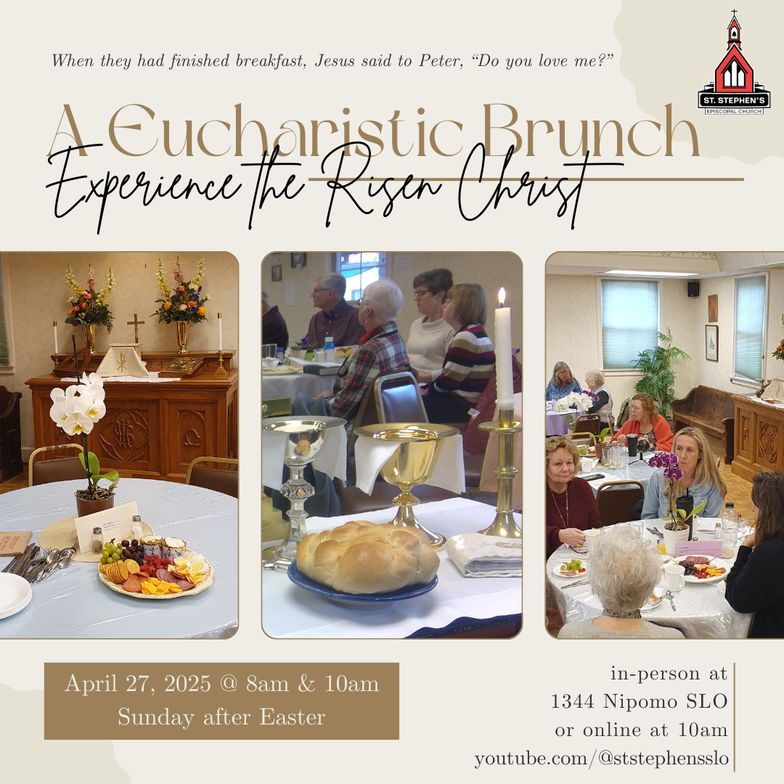
Introduction to The Eucharistic Brunch
Note: Readings for the Third Sunday of Easter
This morning, our Eucharist will be in the context of a meal. If you have not experienced this type of Eucharist before, it may seem a bit strange. In actuality, the way we celebrate the Eucharist is strange. The sharing of the Eucharist in the Early Church was always in the context of the meal of the day.
Jesus, as a Jew, instituted the Last Supper in a traditional Jewish context. It was the Passover, and Jesus asked His Disciples to prepare for the annual celebration in the traditional way. In Judaism and in 1st Century Palestine, the opening of a meal by giving thanks often focused upon bread. The father of the household opened a meal by taking a loaf of bread, giving thanks, breaking it, and distributing it. We will do that shortly, before we eat.
But first: The Lord be with you. And also with you. Let us pray.
Collect of the Day
O God, whose blessed Son made himself known to his disciples in the breaking of bread: Open the eyes of our faith, that we may behold him in all his redeeming work; who lives and reigns with you, in the unity of the Holy Spirit, one God, now and for ever.
Feast and Reflect
While we enjoy the food, Fr Ian will say a few words. Then you will be given a conversation piece.
Our Gospel today is actually set for the next week, but I won’t be here, so I moved it to today. The middle part of it is my favorite post-Resurrection story. I’ll share it with you again:
When Simon Peter heard that it was the Lord, he put on some clothes, for he was naked, and jumped into the sea. But the other disciples came in the boat, dragging the net full of fish, for they were not far from the land, only about a hundred yards off. When they had gone ashore, they saw a charcoal fire there, with fish on it, and bread. Jesus said to them, "Bring some of the fish that you have just caught." So Simon Peter went aboard and hauled the net ashore, full of large fish, a hundred fifty-three of them; and though there were so many, the net was not torn. Jesus said to them, "Come and have breakfast." Now none of the disciples dared to ask him, "Who are you?" because they knew it was the Lord. Jesus came and took the bread and gave it to them, and did the same with the fish. This was now the third time that Jesus appeared to the disciples after he was raised from the dead.
First of all, this is one of two instances in the Gospels that nudity, both of which are not presented as being lewd. The other one is in Mark’s Gospel just after Jesus’ arrest. An unknown man loses his loincloth while being pursued by the authorities, and he runs off.
But what really draws me to this part of the story is the Breakfast on the Beach with Jesus. What a wonderful way to engage with the resurrected Lord! It’s not a rally; it’s not a lecture; it’s not a prayer session in a mega church with a praise band and a fog machine. It’s Jesus and His closest friends who share a breakfast of freshly-caught fish and bread after a long night of fruitless fishing. And that’s why we have the smoked salmon pinwheel on the table: to signify the fish and the bread.
Meals together can be very powerful. The Last Supper – for example – was not only the Institution of the Holy Eucharist, it was in the context of the Passover Meal, which Jews still observe to this day.
The Holy Eucharist is at the center of our worship life together. And while it is no longer in the context of a meal, it has deep meaning for many of us here. It is our engagement with Jesus.
That brings me to brunch conversation:
Does sharing meals with others have a Christian spiritual significance for you? Can you remember a time when you felt closer to God through the meal shared with others?
For me, the preparing and sharing of food can be a deeply spiritual experience. That was what I focused on when I traveled around the world 2 years ago to look at Christian-specific foods and produce a videos series on it. But for a specific example, it would be when we thought my mother was dying in November 2022 (she didn’t die, by the way). It was Thanksgiving Week, and all 4 Delinger kids gathered at my mother’s to sit vigil with her. Amid the advice from hospice, and visits from a few friends, and conversations about ‘what next’, we talked about what we should do about Thanksgiving Day. Should we have a big meal around the dining room table as our mother lay dying in the living room? Or should we just sit around? Those of you who have sat vigil with a loved one know that there are many ‘real life’ considerations to make because it’s not the intense 15min of sitting vigil that we see in the movies.
We decided to have a grand Thanksgiving Dinner, and because we all know how to cook, we could all make our contributions without any commotion in order to maintain the serenity required for the purpose of our gathering together. When Thanksgiving meal time came, one sister sat with Mom while the rest of us ate, and then when the other sister was finished, they swapped duties. To share that meal – even in a cloud of death over us – was a deeply spiritual experience for me. I felt the presence of the Holy Spirit; I felt closer to my siblings; I felt strongly connected to my mother. It was on that day that the 4 of us realized that we had not celebrated a holiday together – all 4 of us together – for probably 40 years! We’ve all been together a couple of times, but never for a holiday. There’s a significant age gap; our lives have taken us different places; our parents have lived 1,500mi apart for 50yrs; 2 of us lived abroad; and there are several sets of in-laws. So this was a truly special moment, and we expressed to one another that our mother probably was doing this on purpose so we would all be together for Thanksgiving! I felt the Holy Spirit, and it was deeply spiritual to prepare and share food in that way and at that time.
So … Open Conversation #1 – the side of the paper labeled “Conversation 1”. Discuss at your tables:
- Does sharing meals with others have a Christian spiritual significance for you? Can you remember a time when you felt closer to God through the meal shared with others?
I’ll give you 12min for your conversation. (10am) When you hear the music play, that’s your cue to wind down your conversation.
More Reflection
In the last part of the Gospel reading, Jesus reverses Peter’s 3-fold denial after the Last Supper and during His trial. 3 times Jesus asks Peter if he loves Jesus; and 3 times Peter – with increasing defensiveness – says that, of course, he loves Jesus. And Jesus commands: Feed my sheep. As followers of Jesus, we are called to feed His sheep, a pastoral way of saying: Spread the Good News and draw others into the Heavenly Banquet.
So, my conversation question for you is:
- How can your experience of food and spirituality feed others in your circles of influence?
Again, I’ll give you 12min. (10am) When the music starts, that’s your key to bring your conversation to an end.
Music to bring Conversation to an End
When you hear the music, please wind down your conversation.
I hope you enjoyed your conversations. Take a look at who is at your table; jot down their names. I strongly commend to you to continue your conversations in your table groups. Find a time to meet for coffee or in one of your homes to carry on the conversation and to explore the side conversations and tangents you didn’t have time to explore this morning.
Take these conversations with you, and reflect and pray. As we move through the Season of Easter, we will hear stories about how Jesus’ resurrection empowered the Disciples to do what Jesus was training them to do in the first place: To proclaim the Good News to others. While you reflect and pray on these conversations we have had today, think about how you can be a Disciple, and how you can Feed my sheep so that they may come to believe that Jesus is the Messiah.