Second Sunday after The Epiphany

May the words of my mouth,
and the meditations of all our hearts
be acceptable in Your sight,
O God, our strength and our redeemer.
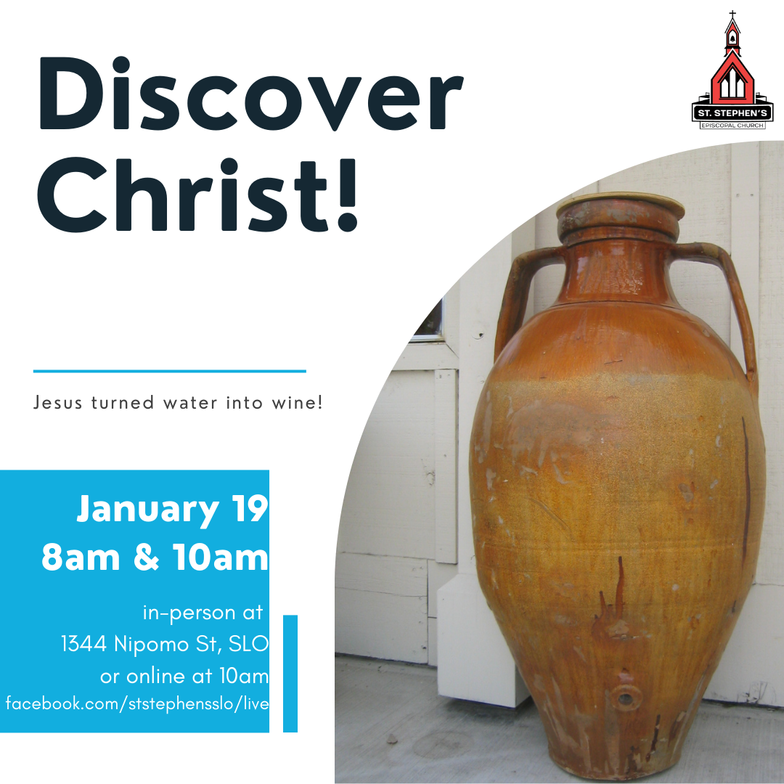
Jesus turning water into wine is probably the top biblical reference by people who comment on the priesthood to someone who is a priest. Something, like
“I bet you’re fun at parties since you can turn water into wine!”
I try to laugh, and then gently remind them that I’m not Jesus, and it was Jesus who turned water into wine. But what I didn’t know until very recently is that winemakers turn water into wine, and there is an actual technique called “Jesus Units”. This is how it was described to me at a wine festival by someone in the wine industry (imagine a low, gravely Australian accent):
The “Jesus Units” is where you’ve gotta vineyard somewhere in the heat. Your vineyard manager didn’t get in there in time to pick the fruit at a lower sugar level or bricks, so unfortunately you have to pick the fruit at say 32 or 35 bricks, which on a scale of sugar is super high. Well, how do you fix that? How do you lower that sugar level? You bring in a big jug of water, you pour it in, and therefore you make that one jug of wine into 5 jugs of wine. What Jesus did was, He had very high alcohol wine and was like, ‘I can’t serve this.’ And He went out to the kitchen, and He took his one jug, and He put water in the wine, and He came back and said, ‘Here you go guys! It’s a miracle!’
He did offer a caveat as well as some industry detail:
It’s not necessarily listed in the Bible, but it’s associated with winemaking. All kidding aside, if you’re making a cheap wine or you’re making a wine that you wanna make in volume, what’s the cost for a gallon of water? 10 cents. That gallon of fruit juice is gonna cost you a lot more. So if you can do a one-to-five ratio, you’re doing really well. How do you make a skinny wine, low-calorie wine? Put it under the tap. I’ll show you how to halve the calories in a wine. You give me 3oz and I’ll put another 3oz of water in there. Guess what. The alcohol will have dropped in half.
In short, quoting a NYTimes article on winemaking:
Pouring water into the wine is the low-tech answer to high alcohol content, referred to in the wine industry as adding “Jesus units.”[1]
No disrespect to the person who told me the story. He didn’t invent the term, and it naturally came up in our conversation about winemaking. But the use of the term “Jesus Units” for diluting wine to make a larger volume somewhat suggests that Jesus’ first miracle was purposefully deceitful. The person who coined the term or made it popular within the industry – it seems as if they don’t trust that miracles can happen, or that Jesus could perform miracles, or that anyone would do such a kind act for the bridge & groom and for the whole community. Never mind that it ignores the whole story and only focuses on Jesus turning water into wine.
I think there is a mindset in many people that others always have a hidden agenda for personal gain, that there is no such thing as an altruistic act – which is a storyline in an episode of Friends, between Phoebe and Joey. I think that many people, when they think about miracles, think about miracles for themselves – to be cured of a disease, to win the lottery or to be beautiful. But Jesus’ miracle today was for the whole community. He doesn’t even get credit for the miracle, the groom does. Only the servants who brought Jesus the water knew of the miracle, so Jesus didn’t even take this as an opportunity to show off. That’s the difference between magic and true miracles: Look what I can do! Vs. How can I help you? All of Jesus’ miracles help others, not Himself.
With the whole village gathered for what would be a week-long wedding, Jesus’ first miracle, He knows that it would be an embarrassment to the groom if the wine were to run out. So, Jesus takes these huge jugs of water and turns them into the finest wine – which is another indication that the creator of the term “Jesus Units” didn’t actually read the story! His high school English teacher would be appalled! So, Jesus saves the party, and the whole village can celebrate the union of this couple in the manner in which all were accustomed.
Were Jesus to have been deceitful, as some thought He was and believed Him to be a false prophet, but were He to be truly deceitful, He probably would have fared better in His 1C Palestinian context, to be honest. Deceit and corruption were the norm, and Jesus came and preached a way of life contrary to that, and He enacted His ministry in ways that benefited those who were most harmed by the deceit and corruption around them. Most agree that the good stuff Jesus did is stuff that we should be doing today. So, from that perspective, He’s all right. It’s just the Son of God and miracles stuff that’s bad.
If any of Jesus’ miracles were intended for deceit, I think it would be easy to recognize. It’s really hard to cover up deceit long-term, unless you really lose yourself into the persona that enables the deceit. Those who believed Jesus to be a false Messiah were many, and they were following Him and challenging Him. The most powerful people in Galilee, Judea and Jerusalem were out to get Him. If Jesus were really a conman, there would be surviving documentation of that in ancient Jewish records.
So, were Jesus’ miracles products of deceit and corruption, but His teachings on how to treat one another basically fine? CS Lewis says that you can’t do that. He wrote in a compilation book of essays “Mere Christianity” that it is foolish for anyone to say:
‘I’m ready to accept Jesus as a great moral teacher,
but I don’t accept His claim to be God.’
In other words, being a good guy is OK, but the miracles have got to go – along with The Resurrection and Ascension. But CS Lewis says:
A man who was merely a man and said the sort of things Jesus said would not be a great moral teacher. He would either be a lunatic — on a level with the man who says he is a poached egg — or else he would be the Devil of Hell. You must make your choice. Either this man was, and is, the Son of God: or else a madman or something worse. … [L]et us not come with any patronising nonsense about His being a great human teacher. He has not left that open to us. He did not intend to.
If Jesus were a great moral teacher and not the Son of God and a miracle worker, then He was lying to people, and therefore immoral! Jesus didn’t dilute the wine to amaze His followers or win followers. He made water into wine to save the community. His miracles were part of His moral teaching.
- In His healing of the 10 lepers (Luke 17:11-19), only one leper thanked Him. Jesus was bewildered at why only the Samaritan returned to Him, praising God. Jesus’ moral teaching was to be grateful.
- Giving sight to the man born blind (John 9:1-38) caused the authorities to question Jesus’ healing on the Sabbath and for the people to drive the healed man out of town. His moral teaching was that people are more important than the rules, and that many are spiritually
- When Jesus stilled the storm (Matthew 8:23-27), it wasn’t a party trick. It was to demonstrate that the disciples lacked any basic faith. Have faith in your skills and abilities, and utilize them to do good.
Maybe the moral teaching behind “Jesus Units” in the wine industry is that no one needs a 15% alcohol content Chardonnay! Pick your grapes earlier!
So, this first of Jesus’ miracles – turning water into wine – still has value for us today. Perhaps as we mature as Christians, it’s less about realizing that Jesus is the Son of God during the Season of Epiphany and more about mimicking His actions. He used His gift to benefit the wider community.
In our second reading from 1 Corinthians, we are reminded that we, too, have spiritual gifts from the Holy Spirit. These gifts are to be used for the benefit of others, and not with a hidden agenda for personal gain. Maybe the moral teaching behind the Wedding at Cana is for us to be activated by the Holy Spirit more often and to use our spiritual gifts for the good of the wider community. As followers of Jesus, we follow His examples. We cannot turn water into wine, but we can,
illumined by Word and Sacrament, shine with the radiance of Christ’s glory
for the good of God’s people.
[1] https://www.nytimes.com/2017/02/02/dining/winemaking-symposium-sacramento.html