Maundy Thursday 2025

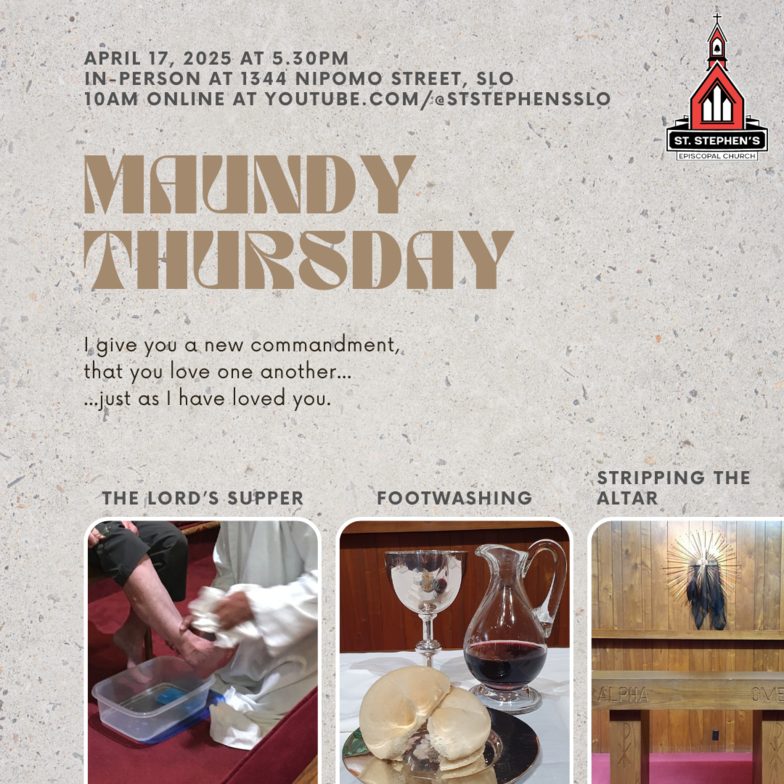
I think Peter’s actions in this evening’s Gospel reflect a powerful mirror on those of us in the Western, middle-class Church. He initially rejects Jesus’ act of humility and kindness. It’s too demeaning to Jesus, and it’s too intimate for Peter. ‘Let’s just get on with what we came to do.’ But then in a second misunderstanding, Peter misjudges the offer and blunders the moment again.
It was normal for one’s feet to be washed when they entered the house. Though, it would be a household servant – who was not a Jew – who would wash the feet as the household returned, or the feet of guests. While we view Jesus’ act as humbling, the Disciples would have seen it as degrading. For Peter, it is beneath Jesus to wash their feet, so he refuses. He can’t accept this act that is freely offered out of love.
Why I see this as a mirror held up to us in the Western middle-class church is that we, too, reject acts of love from those close to us. I often wonder why so many people politely turn down offers of assistance when they are openly struggling. Whether it’s being a caregiver to a sick husband, overwhelmed by competing priorities or not coping well with grief or loss, many people neither seek help nor accept offers of help.
Sometimes I ask the person who refuses help what they would do if so-and-so were suffering the same way. The response is always, “Of course I would help them!” And I respond, “Then let us help you.”
One person recently told me that they don’t like having lost their independence. I began to see the connection between independence and help: admitting you need help and accepting it suggests that you are dependent rather than independent. Our culture looks down on those who are dependent.
Jesus washed the feet of His Disciples. The motivation wasn’t to make them feel superior or to somehow humiliate them or to make them indebted to Jesus. It was deeply symbolic of Jesus’ Death; it was an act of the humility of servant leadership; it was an act of healing and love. It was an act that was to be paid forward:
So if I have washed your feet, you also ought to wash one another’s feet.
To accept the kind acts of a neighbor or church family – to have Jesus wash your feet – is to admit that you are vulnerable, and it requires you to be vulnerable during the act. We in the Western middle-class Church are not comfortable with being vulnerable around other people.
We see each other at church wearing our Sunday best. I don’t want you to see me in my pajamas, in pain, recovering from surgery. I don’t want you to see me weep as I clear out the closet. I know that you are well-meaning, but I feel pitiful.
So, what do we do? We rely on the servant to wash our feet: we buy in the support. We have our meals delivered. We hire a cleaner. We have any number of support services do wellness checks several times a week until it’s several times a day, and then eventually full-time.
Jesus – as challenging as He is – just wants people to know God’s love. He shows His Divine Love through healings, parables and miracles. He does this both in large public forums like the Feeding of the Multitudes, and in intimate settings with His inner circle like the dinner He had with His friends Lazarus, Martha and Mary when Mary anointed His feet with priceless perfume.
This time with Jesus was confusing to the Disciples.
You do not know now what I am doing, but later you will understand.
The footwashing was a simple sacrifice, that pointed to the greatest sacrifice that will soon take place. Then they will understand. ‘But now, just accept this act; let’s just spend some time together.’ But that’s too hard – at least for Peter. It requires vulnerability and intimacy. It requires you to remove your sandals and reveal your dirty and perhaps smelly feet. It exposes your worn-out feet, with the scars and blisters and uncut toenails of decades of walking and working. It requires your dear friend to see up close all of your imperfections that are usually hidden by your sandals. For a servant to see that and experience your filthy feet is his job. For your Lord and Teacher to do this is not only beneath Him, but you become exposed by His act. You must forfeit a tiny bit of your independence – you must be vulnerable. No! It’s easier to hire in our help because that’s their job. They can see your dirty toilet and the spoiled food in the fridge. You don’t lose your independence; you don’t have to be vulnerable.
But every generous offer is an act of humility, generosity and love. It is Jesus’ healing hands washing your feet. Why wouldn’t you want Jesus to wash your feet with His healing hands? He wants your dependence on Him; He commands your dependence upon Him. He gave you His Body and His Blood so that you will be dependent on His love:
Do this in remembrance of me.
Your whole history of faith is based on dependence upon God. Jesus came as human flesh to remind you of that. Self-reliance, complete independence, lack of vulnerability are not qualities of the Judeo-Christian faith tradition. That is evident in the Psalm:
I love the Lord, because He has heard the voice of my supplication,
because He has inclined His ear to me whenever I called upon Him.
We are to trust in God – trust in Jesus’ healing hands washing our feet. Then…when you understand trust and vulnerability:
If I have washed your feet, you also ought to wash one another’s feet.
You are Jesus’ hands and feet in this world. To decline a kind act from your church family is to decline the healing hands of Jesus. To do a kind act for your church family is to be the healing hands of Jesus. That is what Peter doesn’t understand.
But, Peter’s multiple misunderstandings in this short scene give me hope. And this will not be Peter’s last mistake before Jesus is crucified. He will fall asleep in the Garden of Gethsemane, not just once but twice! And the biggest betrayal of all is that, while Jesus is on trial, Peter distances himself from the scene and denies knowing Jesus at all … 3x. All of this is as Jesus is nearing His most desperate moment, yet Jesus keeps Peter in His inner circle; Jesus doesn’t abandon Peter for his grave mistakes.
Jesus loves you and offers to wash your feet, even when you make mistakes:
- When you deny that you are His follower;
- When you ask for more than He is offering;
- When you fall asleep when He needs your companionship;
- When you decline His healing hands to wash your feet.
Welcome the healing hands of Jesus through your church family. Be more dependent upon one another. Allow yourself to be vulnerable with each other. Make mistakes with one another. Be Jesus to one another.
By this everyone will know that you are my disciples,
if you have love for one another.
And when you experience the love for one another and with Jesus and you ask yourself as in the Psalm:
How shall I repay the Lord * for all the good things he has done for me?
Jesus has one simple response:
Sit with Him in the Garden of Gethsemane for just one hour.