Fifth Sunday in Lent

I’m too young to remember watching the Coronation of the United Kingdom’s Queen Elizabeth II in 1953. For the first time in British history, the commonfolk of the kingdom – and a good portion of the world – would get to witness the Coronation without having to be a royal or a prominent politician. But those television viewers were far too common to witness the whole thing. As BBC Correspondent Mark Easton wrote in a 2013 article:
[I]n the middle of it all, a section of the service was conducted in secrecy. The Act of Consecration is the most magical aspect of an English Coronation, so extraordinary that history (and the 1953 Coronation Committee) decreed it must remain out of sight.
And this is what remained out of sight:
[T]he archbishop poured some “blessed oil” of orange, roses, cinnamon, musk and ambergris, and anointed the Queen in the form of a cross, on the palms of her hand, on the breast and on the crown of her head. As he did so, he whispered these words: “Be thy head anointed with holy oil: as kings, priests, and prophets were anointed. And as Solomon was anointed king by Zadok the priest and Nathan the prophet, so be you anointed, blessed and consecrated Queen over the Peoples, whom the Lord thy God hath given thee to rule and govern.”[1]
By the way: ambergris is basically sperm whale vomit – but it’s very highly prized for its scent!
I’m disappointed but not surprised that the Archbishop left out the reference to Mary anointing Jesus’ feet with the priceless nard. This is not only an intimate moment in the company of Jesus’ closest friends, but also the foreshadowing of His Death and the anointing of His body. A paragraph later in John 12 is Jesus’ Triumphal Entry into Jerusalem. This moment with Mary, Martha and Lazarus is the calm before the storm. As we will hear at the beginning of next week’s service, Jesus will arrive in Jerusalem with a great crowd greeting Him with palm branches, setting Him on a donkey and shouting “Blessed is the one who comes in the name of the Lord!”
But this is Mary’s moment, her opportunity to show her love for her friend, whom – through her actions – she knows will be soon put to death, and whom she knows to be the Messiah: the Anointed One. So, she anoints Jesus – regardless of the financial cost, because the cost of not always having Jesus with her was much higher.
Messiah means “Anointed One”. And while Jesus is the Messiah, the Christ, anointing has been a symbol of the divine touch for millennia. In the Church, anointing is typically the Sacramental use of oil as an outward sign of God’s active presence. Anointing is part of healing, for initiation as in Baptism and Confirmation, and for the ordinations of Bishops, Deacons and Priests. Anointing with oil often includes the laying on of hands as prayers for healing, initiation or ordination are said.
Anointing with oil is a very old practice, evidenced by the anointing of priests in central Syria as far back as the 13C BCE. Anointing is mentioned throughout the OT. And when Israel anointed kings, they believed that divine attributes were absorbed by the skin through the use of the oil[2]. The anointing of the high priest removed him from the realm of the profane into the sacred realm – to handle the sancta like the oracle.
At our ordinations, the Bishop anoints the hands of the newly ordained priests, saying:
May Jesus Christ, the great High Priest and Chief Shepherd of our souls,
anoint you by the power of the Holy Spirit for the sanctification of God’s people.
It is a powerful act to consecrate and sanctify our hands so that whatever the priests may bless may be blessed, and whatever they consecrate may be consecrated and sanctified. This is renewed annually at the Renewal of Ordination Vows…which also happens to be the service at which the holy oils for healing and for initiation are blessed by the Bishop. It is called the Chrism Mass.
So, the Church continues this holy tradition that Mary does for Jesus. Anointing is a holy act, and we do it with holy oils. It’s not only a holy act; it’s an act of divine love.
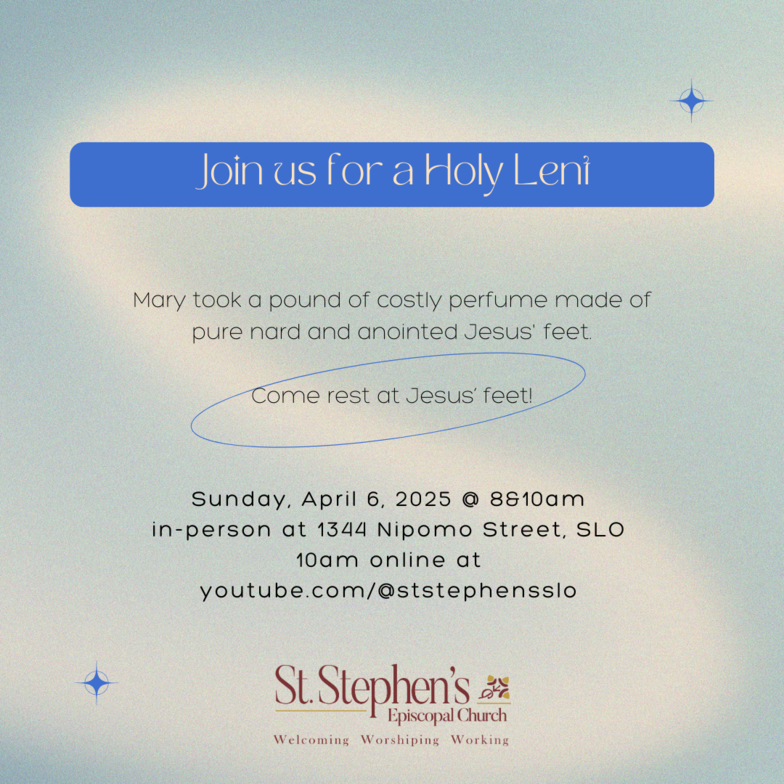
Here at St Stephen’s, we have a Healing Service once a month at the Wednesday 12.15 Service. During that service, there is an opportunity for the laying on of hands and anointing with oil as a prayer for healing of body, mind and soul is said. So, you don’t have to wait between your Confirmation and your deathbed to be anointed, to receive this bestowal of God’s grace, to separate you from the profane and bring you into all that is sacred. Anointing is available to everyone who desires to meet God in that way.
The 1953 Coronation Committee felt that the anointing of the new monarch was too holy for anyone not in Westminster Abbey to see. How interesting. An act of God that can only be witnessed by the world’s elite? That’s not the God we see in the Gospels. We see God in the house of His friends for dinner. We see God who gave Himself in Bread and Wine in a public establishment. We see God who died very publicly on a cross in between 2 criminals. In the human realm, there is nothing too holy for God’s people. We are all invited into the sacred, daily, to sit at Jesus’ feet in a moment of love and holiness.
I hope some on the Coronation Committee realized their mistake. The Church has made sure that it is not only monarchs and clergy who receive God’s blessings through anointing. Every person becomes an Anointed One at their Baptism and Confirmation, in their sickness and at their death. We are all invited into the sacred life of Jesus Christ.
And because Christ invites us into a sacred bond with Him, I invite you to have your hands anointed, with the laying on of hands, and a prayer for God’s guidance. At the end of the Prayers of the People, I will invite you to come forward as you choose, to lay open your hands and to be drawn into a sacred union with Jesus: the Anointed One, the Messiah.
So, let us now stand and affirm our faith in the one who invites us into the sacred realm.
[1] https://www.bbc.com/news/uk-22764987
[2] www.jewishvirtuallibrary/anointing