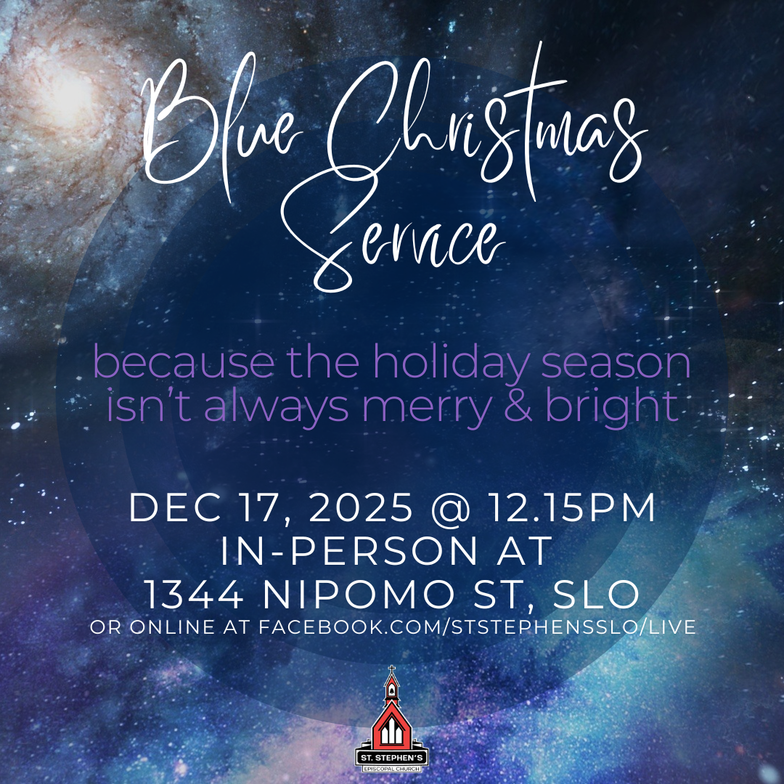
A Blue Christmas Service

Let us call upon God Who was, Who is, and Who is to come.
By the tender mercy of our God, the dawn from on high will break upon us, to give light to those who sit in darkness and in the shadow of death, to guide our feet into the way of peace.
The Song of Zechariah or the Benedictus is our Gospel reading today. It is one of the canticles for use in Morning or Evening Prayer. It starts with a song of thanksgiving for the redemption of God’s people, and then he rests that redemption onto the “the dawn from on high”, Jesus, whom John the Baptist will proclaim as he prepares the way for that dawn from on high. It’s a song of hope for the promise that is almost here!
During this season of Advent, we are continually reminded that the Messiah, the Christ, will turn everything upside down…and for the better. On Sunday, we were reminded that, through the Messiah:
the blind will receive their sight, the lame will walk, the lepers will be cleansed, the deaf will hear, the dead will be raised, and the poor will have good news brought to them.
And through Zechariah, we are reminded that we will:
be rescued from our enemies, have our sins forgiven, our darkness will be turned to light, and we will be guided into the way of peace.’
All of life’s negatives will be turned to positives.
December, though, is sometimes hard. Out there is the unbridled rejoicing and conspicuous consumption. Many don’t want to be a part of that, and find it difficult just being out in public because of the forced merriment. And in here, we’re being told that we have to continue to wait! The saving grace is always coming, and it never feels like it’s here!
And so, we take this opportunity to bring those feelings here, sit in darkness together, and lift it all up to the Light.
I want to share a personal story that resonates with why we are here today.
As many of you know, I went to seminary and was ordained in England, and I served in the Church of England for quite a number of years. My first two Christmases in seminary, I returned to the United States and visited family. My 3rd Christmas in seminary, I stayed in Cambridge and went to Christmas dinner at my tutor’s house. That was a bit awkward! But it beat staying in my room in the college all by myself.
The December of my first year of being ordained, and serving in Manchester, was met with mixed emotional response. Just like here, St. Clement’s in Chorlton-cum-Hardy had 3 Christmas services: the Family Service in the late afternoon, Midnight Mass, and then a service on Christmas morning. The Rector, the Church Army Officer and I, the curate, shared responsibilities to make sure the services were delivered without a hitch!
Advent, the time leading up to the Christmas services, is a lot busier in a Church of England parish than it is here. It’s still appropriately Advent inside the church and commercialized Christmas blitz outside the church. But we hosted several Carol Services for local organizations, our own Civic Carol Service, our Christmas fête, and the beloved Christingle Service for the small children. All lovely. But then Christmas Day came.
Culturally, the English are not prone to invite people to their Christmas and Boxing Day celebrations. It’s not in their culture to even think about whether or not someone has a place to go for Christmas Day. I was often asked if I was going home for Christmas! To which I would respond, “I don’t think the Rector would like it if I went away at Christmas!” And at that point they would realize what a dumb question that was!
So after finishing the Christmas morning service, I went home to my house with my 2 cats, an old television with only 4 channels, and I have no memory of what I had for dinner. Everything is closed on Christmas Day, including public transportation. The exception is the pubs that are open only for a short window of time. I’ve been told that the Christmas morning tradition was that the women cook, and the men go down to the pub, and when the pub closes, the men go home and everyone has their Christmas dinner. I didn’t know that tradition at that time, or I probably would have gone down to the pub! So, there I was on my own.
It was the saddest Christmas I have ever spent. Not one person thought to ask me if I had plans for Christmas dinner. My family was 6,000 miles away. More significantly, my family was a month-and-a-half’s paycheck away. So, I wasn’t just alone, I was isolated, lonely, and sad. That went on for two days because it is a similar cultural dynamic for Boxing Day. It was a really sad time for me.
But Zion said, ‘The Lord has forsaken me, my Lord has forgotten me.’
I came to find out about a month later that someone I was ordained with had also spent a sad Christmas Day alone. Gennie’s family was far away, and she didn’t have much family. So when she finished her services, she too, was at home alone with her two cats.
When I told her how sad my Christmas was, she said to me, “Why didn’t you call me?” “I didn’t think to call you because I just assumed that you would be with your family doing family things,” I replied. So we made a pact that we would make sure that the clergy we knew were single would not be alone at Christmas or Easter.
The next Easter, after our services were done, 3 other priests came to my house for Easter Dinner. And the following Christmas, Gennie hosted me at her home for Christmas Dinner.
Of course, now, I’m over it. It’s been 21 years. But it is a memory that I have of a very lonely time in my life where I was genuinely sad about my condition. And I really felt that no one cared. So, as much as I don’t want anyone to be lonely and sad at this time of year, I know that there are people who are lonely and sad. And that’s why we are here today.
I’m not good with poetry, but I was drawn to The Experience of Prayer that was our second reading. It so vividly captured what we do in our grief and sadness:
We chose to shut our eyes to the darkness that was there,
And saw in the fantastic lights that swam in our fevered eyes
Shutting our eyes and sitting in darkness often feels safer than seeking out the light. Shutting our eyes and sitting in darkness means that we can see whatever we want to see in our mind’s eye. But then we open our eyes, and the real darkness, the grief and sorrow are still with us. But we don’t have the energy to search for the True Light.
The reality is that the True Light, the dawn from on high that will break upon us, to give light to those who sit in darkness and in the shadow of death, is always with us. Jesus is always there…even in darkness, even in our own personal darkness. With prayer and support, we can turn to that Light that is Jesus. And when we see the True Light:
Now can our eyes spring free to see [even] the night,
And the darkness that is vibrant with our God.
Because for the True Light:
Darkness is not dark to you; the night is as bright as the day
There are things in our lives that we don’t have control over that make us sad and lonely or fill us with grief, and we shut our eyes tight so that we cannot see the sadness and grief, and it will go away. And we sit with our eyes closed and feel safe in the darkness. Then sometimes in that darkness of grief and sadness, we think we see light. But we’re only seeing what we think is light, as the poem tells us.
But the True Light is there! We just need to open our eyes! Some of us need help opening her eyes! Others open their eyes and wonder why they shut them in the first place.
When we open our eyes, we will see that God has sent us the True Light, the dawn from on high that will break upon us, to give light to those who sit in darkness and in the shadow of death, the light in the love that is Jesus Christ.